Reflections on World Fantasy Con 2025

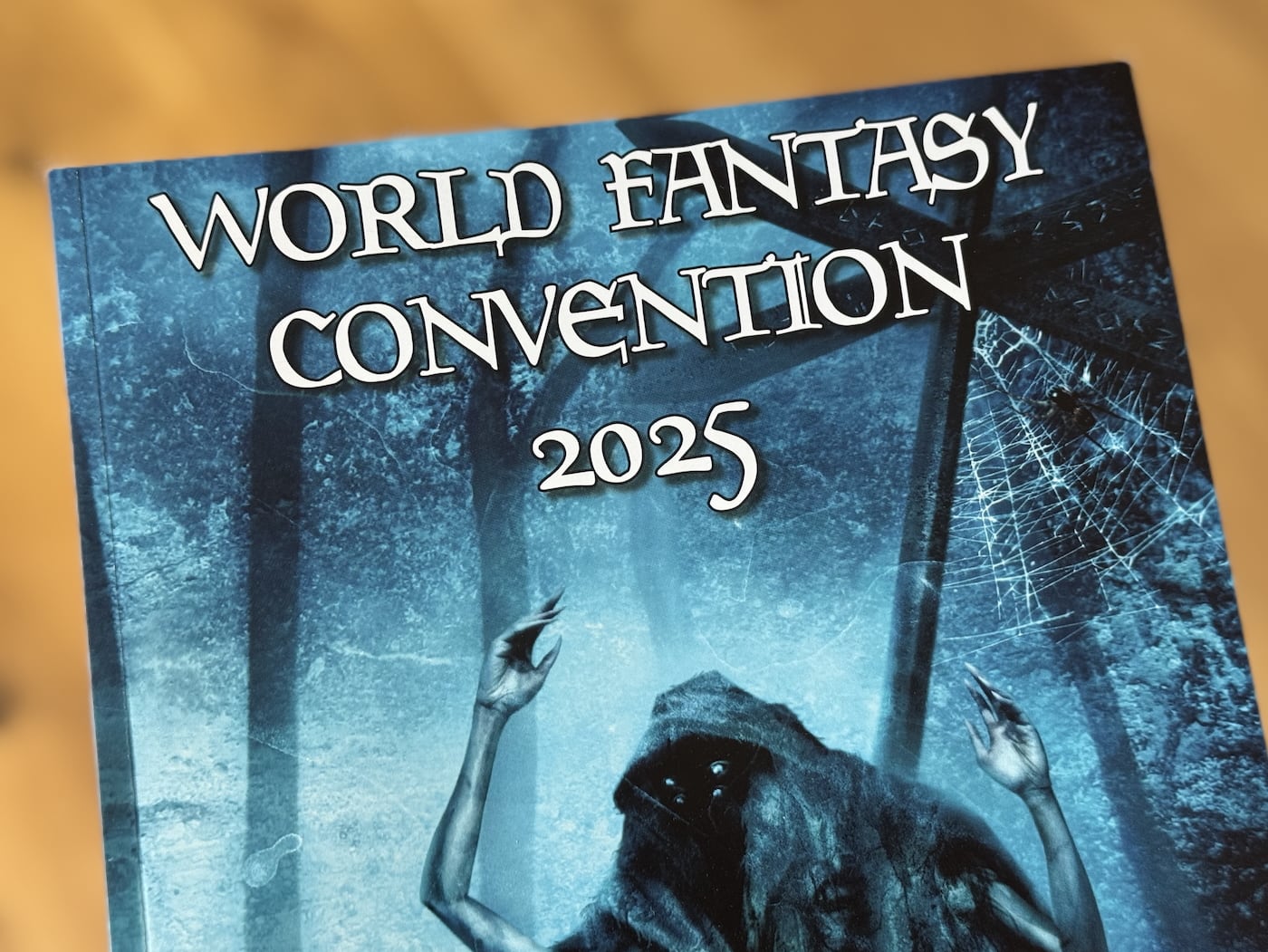
Programme for “World Fantasy Convention 2025” featuring a haunting blue forest background, shadowy trees, cobwebs, and a hooded figure with many glowing eyes.

A couple of weeks ago I wrote about attending Bristolcon, which I try to do every year. This week, I wanted to reflect on the second convention I went to this October, one I’ve never been to before. The World Fantasy Convention is an annual event that, as the “world” in the name suggests, takes place in different countries or cities – though rarely outside of the USA and Canada. This year it joined forces with Fantasy Con, run by the British Fantasy Society, and took place in Brighton on the weekend of Halloween.

This is not the first large international convention I’ve been to – my first was actually Worldcon in Dublin in 2019, and I went to Worldcon again last year when it came to Glasgow. I was curious, however, to see how WFC would differ, especially being a more UK-focused affair with the inclusion of Fantasy Con, and perhaps also a more fantasy-focused affair, given that Worldcon’s full name is actually ‘The World Science Fiction Convention’ and that it has a strong science-fiction focus.

I was also simply curious what it would be like to do two cons back-to-back, and wanted to join other friends who were going. So I set off to Brighton, keen to find out.

Continue reading

Reflections on Bristolcon 2025

Blue front cover of a printed convention programme reads "Bristolcon: booklet of mildly useful facts and fiction of dubious value, best before Nov 2025."

I’ve been a bit quiet recently, but for a good reason at least – a few weeks ago I attended two fantasy and science fiction conventions in the UK. The first, Bristolcon, is a favourite I attend pretty much every year. This October, however, the stars aligned to put the World Fantasy Convention only a week later in Brighton. What’s more, this particular World Fantasy Con joined forces with Fantasy Con (an annual UK-based convention run by the the British Fantasy Society) in a sort of extra-large affair, so it seemed worth going to both.

If you’re getting confused by all the extremely similar con names, you’re not the first… a few times when drafting this post I accidentally wrote “Worldcon” instead of “World Fantasy Con”, which would be an entirely different con yet again.

Anyway, I wanted to share a few personal reflections and highlights from both conventions, but in this post I’ll just focus on Bristolcon to keep things short. I’m also not going to write extensively about everything I attended, because the mere thought is exhausting and because I didn’t take diligent enough notes, so I’ll simply pick out a few highlights that stayed with me.

Continue reading

What is steampunk and why does it exist?

Vintage German postcard shows a bustling cityscape with cars, trams, a suspension railway, a winged postman, and flying machines; caption reads “Berlin in the future"
Historic German postcard that imagines Berlin in the future, Bröhan Museum, Berlin.

I recently visited a city called Wuppertal in central Germany. It’s not your typical tourist destination, but I had my sights set on a particular, admittedly very nerdy, goal: I wanted to ride on the ‘Schwebebahn’, the oldest suspension railway in the world. This truly odd and unique structure was completed in 1901 and is still used today for local public transport… and from my first glimpse, I was charmed. Not only does the railway have an extremely historic “steampunk” vibe, it winds through a city that retains other remnants from that period – rustic old brick factories, billboards in archaic fonts, steel bridges, Art Deco stations.

The whole experience also made me reflect on the moment 6 years ago when I first heard about Wuppertal, which was also, not-so-coincidentally, the first time I fully grasped what steampunk is and why it exists.

Before then, I knew the basic definition of the genre, which Oxford Languages currently supplies as:

  1. a genre of science fiction that has a historical setting and typically features steam-powered machinery rather than advanced technology.
  2. a style of design and fashion that combines historical elements with anachronistic technological features inspired by science fiction.

I also recognised the aesthetics and elements steampunk entails. What I didn’t really understand was why enough writers and artists had imagined this alternative steam-powered future for there to be a whole genre based on it.

Why were people writing these anachronistic fantastical futures filled with cogs and wheels, hot air balloons, zeppelins, and bronze machinery? Why revel in the ‘tech’ of the 1800s and early 1900s and imagine worlds that maintained it? Why focus on a turn-of-the-century aesthetic, as opposed to say, any other period in history?

Continue reading

Negative Reviews That Don’t Turn Me Off a Book

More often than not, it’s the gushing, positive things in reviews that help convince me to read a book, and the negative ones that make me steer clear. However, as I’m sure is the case for many other readers, sometimes criticisms in a negative review won’t actually turn me off… in fact, they’ll make me think the book might be up my alley. This is of course mostly due to personal taste, for example if the reviewer mentions something they dislike that I don’t, and more rarely, due to things that make me suspicious as to the reviewer’s motives. Continue reading

Following the 5th Self-Published Fantasy Blog-Off

I’ve been woefully absent in the blogging world this past month (both in terms of posting here and also catching up with other great blogs I enjoy), so I feel bad about that, but I’m finally getting to the end of other projects so I’m hoping to change things. I thought I’d start with a short post about the 5th Self-Published Fantasy Blog Off that recently came to a close. I’ve been following and enjoying it, so I wanted to share a few links and thoughts. Continue reading

Idols, Friends and Mentors: Alexander von Humboldt’s Influence on Writing and Science

I actually wrote this post several weeks ago, before the corona virus crisis hit on a world scale… but given it’s about the importance of scientists and human beings connecting with and inspiring each other, be it in person or from afar, it actually feels somehow appropriate. So in case anyone’s looking for a positive break from reading about pandemics, here it is:

___________________

I don’t normally read a lot of non-fiction, but I recently picked up The Invention of Nature by Andrea Wulf. Aside from informing me about a brilliant scientist and author called Alexander von Humboldt – who I knew very little about – it got me thinking again about a topic I’ve found myself mulling over often in the past year: namely, how much writers are influenced by the work of other writers who’ve come before them, or even those who are writing at the same time.

In the past, I’ve tended to to look at famous historical figures in isolation, focusing on the unique feats they achieved and how different it was to everything that had come before. Last year, however, when researching for a blog series about popular fantasy books in different decades, I was repeatedly fascinated by how many writers had been inspired by, or even been good friends with, other writers on my lists. Continue reading

The Best Fantasy and Science Fiction Books I Read in 2019

I’ve been a bit absent online these past two months, both because of the holiday period but also because I was trying to finish editing my novel-in-progress before the new year. It took longer than expected, but in the end I managed to send it off to beta readers just after Christmas, so that’s at least one resolution achieved! (even if others fell by the way side).

Now that I’m finally back to blogging, I figured I’d start the new year by looking at my favourite reads from the last one. I picked up many great books in 2019 but I’m only going to list the 5 that most impressed me, and I’ll do my best to keep my ramblings on each brief and spoiler-free (if you want to know more about any of them you can click the links to see the blurbs on Goodreads). Continue reading

5 Adjectives That Sell a Book to Me

My last post was about adjectives that turn me off books in promotional material, so this week I thought I’d turn it around and look at some common book-selling adjectives that might make me more likely to read a novel. Of course, no one word alone is going to sell me something, but there are a few that would help pique my interest if other signs are good.

I’ve ruled out obvious genre-markers like “fantasy” and “science fiction” (from the title of this blog it’s already pretty obvious I like those kinds of books), and narrowed it down to five that are most likely to catch my eye or appeal to my personal tastes: Continue reading

5 Adjectives That Don’t Sell a Book to Me

Whether it’s in a blurb, a social media post, an email from an author or publicist, or an advertisement, I often see adjectives used to promote books… and while some of those adjectives do their job well, I’ve noticed others immediately rub me up the wrong way. These seemingly innocuous little words provoke grimaces or eye-rolls, instead of doing what they’re presumably meant to do: make me want to read the book.

Of course, these are specific to me and my personal tastes, but I thought for some fun, and in case it helps anyone know how not to promote a book to someone like me, I’d list a few that stand out. Continue reading

My Hugo 2019 Favourites

Back in June I set myself the goal of reading as many of the finalists for this year’s Hugo Awards as possible, and in the end I was pretty happy with what I managed. So on the awards night at Worldcon I bustled into the auditorium, ready to cheer for my favourites… and not a single of my top picks won! I wasn’t too crestfallen, since I also liked the ones that did win, but it goes to show you how varied tastes are when it comes to awards. Apparently some of the categories were decided by a slim margin of votes, so there was stiff competition.

In light of this, and since everyone always talks about the winners, I thought I’d take this opportunity to give a shout out to some of the finalists which didn’t win, but which I personally thought were fantastic. Continue reading