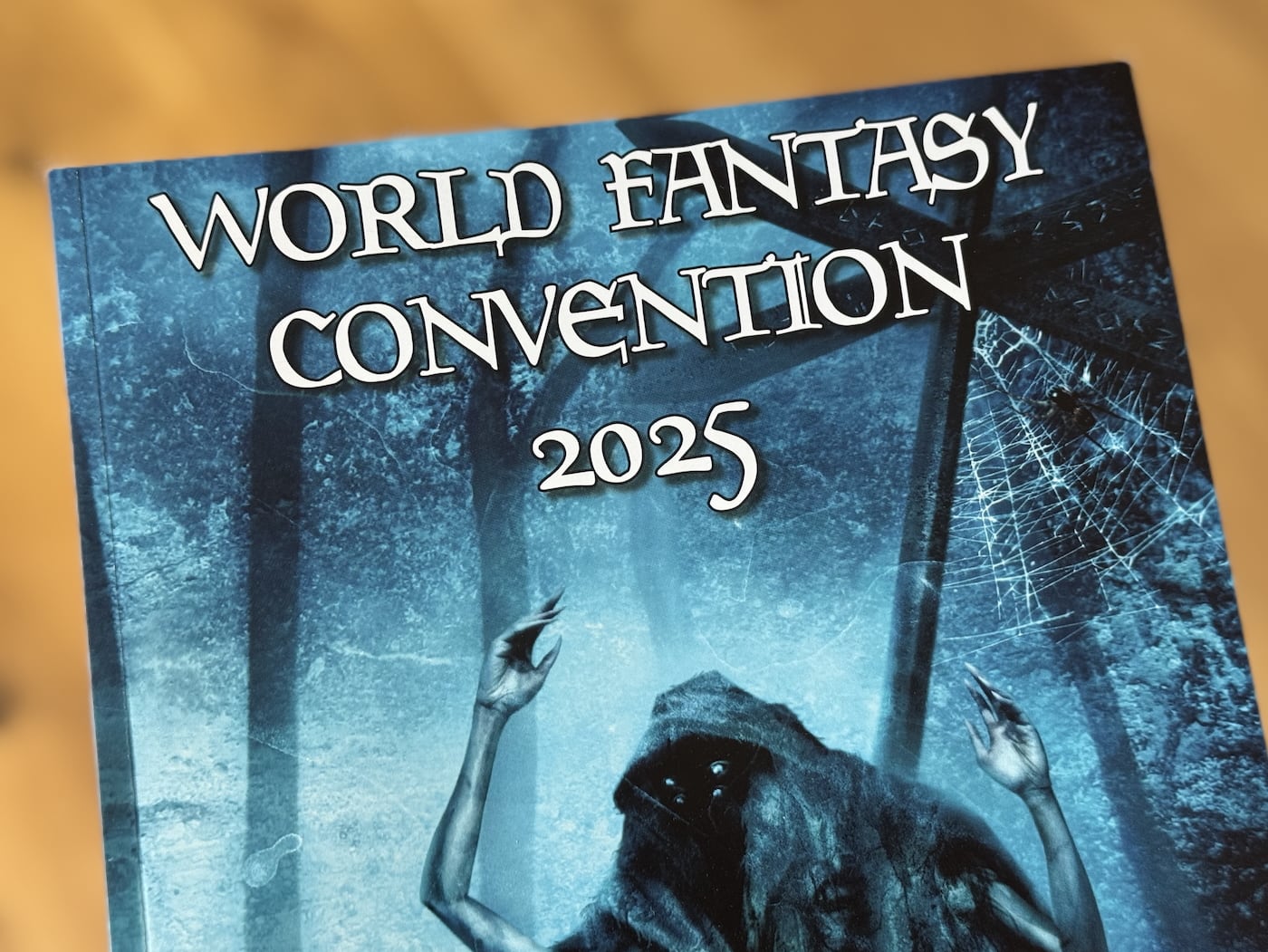
Reflections on World Fantasy Con 2025

Programme for “World Fantasy Convention 2025” featuring a haunting blue forest background, shadowy trees, cobwebs, and a hooded figure with many glowing eyes.

A couple of weeks ago I wrote about attending Bristolcon, which I try to do every year. This week, I wanted to reflect on the second convention I went to this October, one I’ve never been to before. The World Fantasy Convention is an annual event that, as the “world” in the name suggests, takes place in different countries or cities – though rarely outside of the USA and Canada. This year it joined forces with Fantasy Con, run by the British Fantasy Society, and took place in Brighton on the weekend of Halloween.

This is not the first large international convention I’ve been to – my first was actually Worldcon in Dublin in 2019, and I went to Worldcon again last year when it came to Glasgow. I was curious, however, to see how WFC would differ, especially being a more UK-focused affair with the inclusion of Fantasy Con, and perhaps also a more fantasy-focused affair, given that Worldcon’s full name is actually ‘The World Science Fiction Convention’ and that it has a strong science-fiction focus.

I was also simply curious what it would be like to do two cons back-to-back, and wanted to join other friends who were going. So I set off to Brighton, keen to find out.

Continue reading

An Undying Romance: Vampires in Fiction

This week I’m pleased to welcome Kathryn Troy back to the blog – last year Kathryn shared her thoughts on what it means to be Lovecraftian. Now she’s launching the second book in her gothic fantasy series and stopping by to take a look at the enduring appeal of vampires and how she uses them in her work:

Bram Stoker was certainly not the first person to craft a vampire story. Serialized tales like Varney the Vampire and Sheridan Le Fanu’s Carmilla were written decades before Stoker published his novel in 1897. Polidori’s The Vampyre was published in 1819, almost a century before. As serials and penny-dreadfuls, vampire stories had gained a modicum of popularity, which created a climate that was ready to accept Dracula. But it was Stoker who propelled and solidified the genre into the veritable beast it has become.  Continue reading

The Dark Corners of Fiction: Lovecraft’s Effect

What does it really mean to be Lovecraftian? This week I’m delighted to host a guest post by historian-turned-novelist Kathryn Troy, who has just released her dark romantic fantasy novel A Vision in Crimson. Her historical expertise in the supernatural and the Gothic informs her fiction at every turn, and she’s stopping by on her blog tour to take a look at the influence of Lovecraft on speculative fiction:

Howard Phillips Lovecraft is one of the most influential authors in American literature. His craft, his universe, his subject matter and underlying themes are so pervasive in speculative fiction—fantasy, sci-fi, horror, and everything in between—that his impact is seen and heard the world over, even when it isn’t recognized as such.

You’ll be hard-pressed to find a speculative fiction author today who doesn’t know who Lovecraft is, or doesn’t attribute him with having at least a modicum of influence over their own writing. But what does it really mean to be Lovecraftian? Continue reading

The 10 Popular Types of Fantasy Movies

While we don’t hesitate to label a film “science fiction”, it’s a much rarer occasion that we’ll call a film a “fantasy”. Sure, things like Lord of the Rings and The Hobbit and Harry Potter immediately scream fantasy, but beyond these key examples, things can get a little fuzzy. Just the other day, I was trying to think of my favourite fantasy films and found myself floundering. Continue reading