
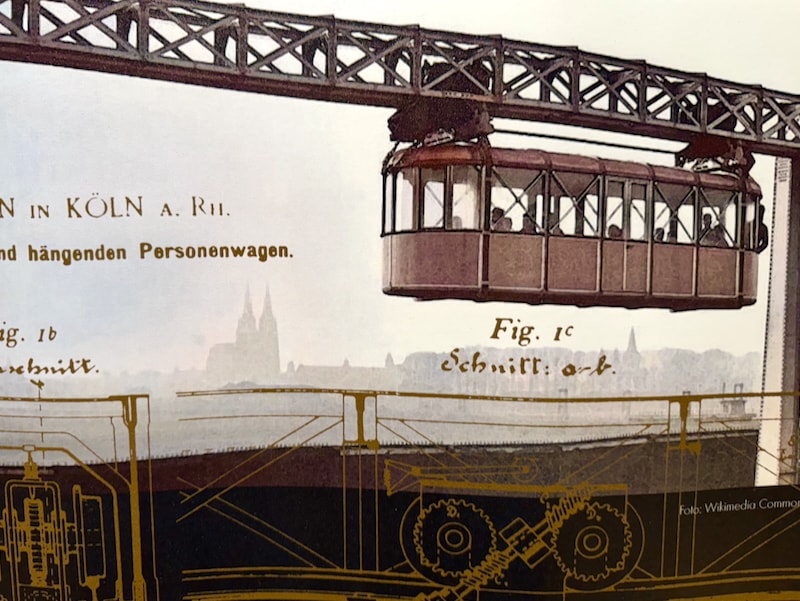
I recently visited a city called Wuppertal in central Germany. It’s not your typical tourist destination, but I had my sights set on a particular, admittedly very nerdy, goal: I wanted to ride on the ‘Schwebebahn’, the oldest suspension railway in the world. This truly odd and unique structure was completed in 1901 and is still used today for local public transport… and from my first glimpse, I was charmed. Not only does the railway have an extremely historic “steampunk” vibe, it winds through a city that retains other remnants from that period – rustic old brick factories, billboards in archaic fonts, steel bridges, Art Deco stations.
The whole experience also made me reflect on the moment 6 years ago when I first heard about Wuppertal, which was also, not-so-coincidentally, the first time I fully grasped what steampunk is and why it exists.
Before then, I knew the basic definition of the genre, which Oxford Languages currently supplies as:
- a genre of science fiction that has a historical setting and typically features steam-powered machinery rather than advanced technology.
- a style of design and fashion that combines historical elements with anachronistic technological features inspired by science fiction.
I also recognised the aesthetics and elements steampunk entails. What I didn’t really understand was why enough writers and artists had imagined this alternative steam-powered future for there to be a whole genre based on it.
Why were people writing these anachronistic fantastical futures filled with cogs and wheels, hot air balloons, zeppelins, and bronze machinery? Why revel in the ‘tech’ of the 1800s and early 1900s and imagine worlds that maintained it? Why focus on a turn-of-the-century aesthetic, as opposed to say, any other period in history?
The moment when understanding finally dawned for me was during a visit to the Bröhan museum in Berlin in 2019, and more specifically, to an exhibit titled Reaching Out for the Future. It transported me into the mindset of that era, and I began to understand where the fertile seeds of steampunk lay… and indeed, of science fiction itself.
Rapid Change and The Age of Steam

It’s impressive to reflect on just how much life changed during the “Age of Steam”. From the start of the 1800s, technological progress was already beginning to accelerate, with revolutionary inventions like the steam train, the bicycle, photography, and the hot air balloon bringing dramatic advances. The spread of the railways even impacted our relationship with time and prompted the creation of time zones.
In the course of the 50 years between 1870 and 1920, this only intensified. Humans went from trotting around in horse-drawn carriages to travelling not only in trains, but automobiles, electric trams, submarines, zeppelins, and planes. They invented diving suits, electric light bulbs, telephones, gramophones, cinema, radio. They built giant factories and erected massive steel structures like the Eiffel Tower. Doctors and scientists made great leaps forward in knowledge, World Expos brought the ‘world’ (and the spoils of colonialism) to the masses in Europe and America.
The Birth of Science Fiction
Unsurprisingly, people began to see all this speedy progress and extrapolate as to what they might achieve in future. Mary Shelley wrote Frankenstein in 1816 – widely considered to be the first work of science fiction – and not long after authors like Jules Verne were imagining journeys to the centre of the earth, to the depths of the ocean, to the moon. H.G. Wells penned The Time Machine in 1895.

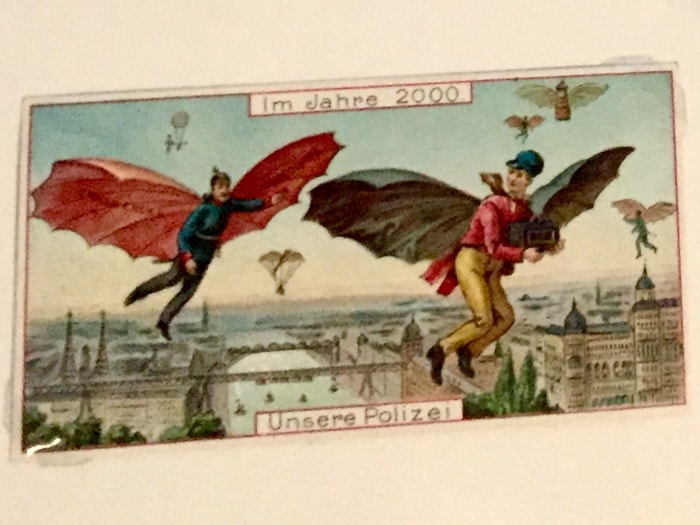
And authors were not the only people imagining where humanity might be headed. In the Reaching Out for the Future exhibit, I was enchanted by displays of postcards that were popular at the time – not of cities as they existed, but of imagined future cities – drawings of streets filled with people zooming along on newfangled gadgets or sailing through the air on fantastically weird flying machines.
Filmmakers fantasised about space travel. The first science fiction film, A Trip to the Moon (Le Voyage dans la Lune), was released in 1902, only a year after the Wuppertal suspension railway came into operation. And Fritz Lang’s film Woman in the Moon (Frau im Mond) came out toward the end of this industrial steam-powered era in 1929.
It was a time full of promise, discovery and innovation, a time when marvels of engineering were being realised and the sky seemed the limit.
Romanticising the Past
Reflecting on all of this, I can’t help but feel that it must have been an incredibly exciting time to be alive… but of course, I’m romanticising it. It was also a time of war, disease and colonialism, and if you didn’t have the wealth, gender, race, or nationality to share in the technological success, it probably wouldn’t have been a peachy time to exist. Those beautiful old brick factories I saw in Wuppertal demanded long and hard hours from their workers, and there are several alarmingly unconcerned historic quotes about the various shades of red and black the Wupper river turned at different times of the day, depending on which chemicals were being dumped into it.
Indeed, some recent steampunk novels, such as Senlin Ascends, explore these less romantic aspects too, encapsulating both the marvellous progress of that age and the exploitation it was built upon.
But still, romanticisation is a key part of the appeal of steampunk as a genre. We take all that promise and hope, that futuristic outlook from an era that now has a quaint, historic sheen for us, and we reimagine it in new ways. We harness those old aesthetics of steam trains, top hats, and flying machines, the nostalgic feel of a Jules Verne novel, those beginnings of science fiction, and we continue to imagine a future akin to the one those early writers and artists might have pictured, but with our own twists and ideas. We fantasise about a world in which innovations like computers and plastic never arrived.
It took me many years to realise that in Philip Pullman’s His Dark Materials series, Lyra’s world is exactly this – an alternative reality where the future we’re living in, for whatever reason, never played out.
The Allure of Both Past and Future
In a way, it seems to me steampunk combines two core appeals of fantasy and science fiction: the romanticised longing for a rustic bygone age, and the wonder of imagining a future built on new technologies. Perhaps this, in large part, is why it has endured.
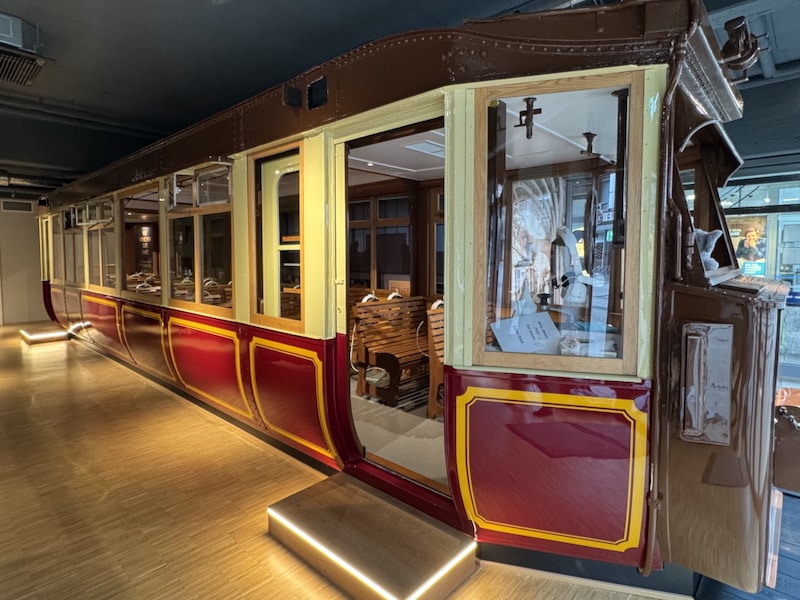
And indeed, there was a wonderful moment during my visit to the Schwebodrom (a museum about the Wuppertal suspension railway) where we all climbed into a historic wagon, put on virtual reality headsets and headphones, and experienced a ride in the Schwebebahn as it would have been back in the 1920s.
Having just ridden in a modern carriage on the suspended railway to get to the museum, I found myself taking the same ride through the Wuppertal of another era, peering around me at streets filled with horses and carriages, ladies and gentlemen promenading along the riverbanks, painted billboards, workshops with brick smokestacks spewing dark clouds. I spied the power plant that fuelled the railway and the BAYER chemical plant – both of which are still there today, if in much changed form (it looked like the power plant was in the midst of being demolished).
Through it all, I felt a wonder and joy at being immersed in the past of a city in its heyday, this intense nostalgia and delight at being transported by a time machine of sorts… one that rounded out my journey toward understanding steampunk which began at that exhibit 6 years ago.
After my visit was over, I glimpsed the screen of the computer that runs the VR simulation – a futuristic looking control panel where the staff manage and check what each visitor sees. I expressed regret to a friendly staff member that I had not spotted the zeppelin that was mentioned in the audio, and he asked which side of the carriage I’d been seated on. Apparently I would have had to be on the right hand side to see the zeppelin gliding high above us, whereas on the left I was treated instead to the scene of a pickpocket making off with a wallet.
I suppose I’ll just have to come back to Wuppertal one day if I want to catch a glimpse of that zeppelin.
_____________
Are you a fan of steampunk? Or do you have any suggestions for favourite steampunk novels I should check out? Let me know in the comments.
Discover more from Thoughts on Fantasy
Subscribe to get the latest posts sent to your email.

That was a fun read while wandering the endless corridors of IKEA! That’s a neat observation that Steampunk combines that kind of sci-fi inventiveness with that more historical halcyon past vibe. Senlin Ascends and Pullman’s His Dark Materials are good examples of the genre. The Wild Wild West was very much a steampunk and gunslingers feel while Kate Addison’s The Goblin Emperor also has that steamy magic atmosphere. I think it’s the airships that do it 😀 – and that VR Wuppertal ride feels very steampunky!
LikeLiked by 1 person
Ah I forgot The Goblin Emperor had that vibe too but yes it definitely did with the airships… I think it even had the nobles planning grand industrial-era-style projects like bridges? Anyway, great book, thanks for reminding me! It’s been ages since I’ve seen Wild Wild West but now you mention it westerns do often merge well with steampunk, I feel like I’ve seen other things that combine those two as well.
LikeLike
Another lovely and thoughtful post. Sounds like a rather unbalanced design regarding the zeppelin and pickpocket experiences. Hope you get that chance to go back and see the zeppelin! As for steampunk recommendations, have you read the trilogy, A Nomad of the Time Streams, by Michael Moorcock? Many consider it a foundational series that helped to popularize and shape the steampunk genre.
LikeLiked by 2 people
Thanks!! And no I hadn’t heard of Moorcock’s ‘Nomad of the Time Streams’, only his Elric books, but that’s great to know it’s considered a foundational series – I’ve often wondered if there was a particular book or books that popularised the genre, since all the steampunk novels I’ve read or heard of seem to come out of a long established tradition already. I’ll have I check it out!
LikeLiked by 1 person
Great post! I’d never heard of the Wuppertal suspension railway before – super interesting, and amazing that it’s still going!
LikeLiked by 2 people
Thanks! Yes I love that they’ve kept it going over all these years, and that it’s just a normal mode of public transport there. Also by now I think it’s become such a key part of the Wuppertal local identity people would revolt if anyone tried to remove it 😅
LikeLiked by 1 person
Sorry for spammy first comment. I was so excited when this first landed in my inbox (I have no idea how or why I subscribed to you) that I just posted on reflex without reading first. Now I’ve read. Thanks for a great article! Don’t neglect the ‘punk’ aspect of ‘steampunk’, which for me has to do with rebelling against other forms of tech which are more insidious and malicious. Other steampunk I would recommend are Jim Butcher’s The Cinder Spires (which he calls a ‘steam opera’), Chris Wooding’s Tales of the Ketty Jay (just absolutely fantastically awesome) and some of the Final Fantasy Games (particularly VI). Inspired by all these and others I have one book out so far in a steampunk-flavoured series. If you want to check it out, it’s called Saga of the Jewels by Thomas Tarasios. Cheers!
LikeLiked by 2 people
I haven’t read much steampunk, but I do love the genre, esp art that depicts it. I learned quite a bit from your post here because I didn’t know of the Wuppertal. It sounds like a wonderful experience, riding railway and seeing how things would have been in the past.
LikeLiked by 2 people
Yes steampunk art can be really cool, I love the aesthetic! Wuppertal is not a common destination to visit, so a lot of people haven’t heard of it outside of Germany, but I was really glad I went. Funnily enough it’s also not far from Neandertal, where the first neanderthal remains were discovered, which was another cool museum visit. So a fun lesser-known corner of the country!
LikeLiked by 2 people
…Sit on the right side and you see a zeppelin. If chance steered you to the left, then you get the pickpocket. I think this is a really neat parallel to your comment about how differently this era would have been experienced depending on which rung of the socio-economic ladder people were on, and that it took some reflection (where are the zeppelins?) and inquiry (talking to the museum attendant) to see a fuller picture. This was a joy to read!
LikeLiked by 2 people