
I’ve been a bit quiet recently, but for a good reason at least – a few weeks ago I attended two fantasy and science fiction conventions in the UK. The first, Bristolcon, is a favourite I attend pretty much every year. This October, however, the stars aligned to put the World Fantasy Convention only a week later in Brighton. What’s more, this particular World Fantasy Con joined forces with Fantasy Con (an annual UK-based convention run by the the British Fantasy Society) in a sort of extra-large affair, so it seemed worth going to both.
If you’re getting confused by all the extremely similar con names, you’re not the first… a few times when drafting this post I accidentally wrote “Worldcon” instead of “World Fantasy Con”, which would be an entirely different con yet again.
Anyway, I wanted to share a few personal reflections and highlights from both conventions, but in this post I’ll just focus on Bristolcon to keep things short. I’m also not going to write extensively about everything I attended, because the mere thought is exhausting and because I didn’t take diligent enough notes, so I’ll simply pick out a few highlights that stayed with me.
Getting there

As in previous years, I caught the train from Germany to the UK. Many people raise their eyebrows at that, and yes, it does take longer than flying, about 7–8hrs total travel time from my starting station in Germany to London, and then an additional couple of hours if you want to get somewhere else in the south, e.g. Bristol or Brighton. But I enjoy the train journey so much more than flying, plus it saves CO2, so I do it anyway.
I use an interrail pass (there are passes for adults), which makes it less expensive than buying individual tickets, and has the added benefit that I can catch other trains during my trip and stay pretty flexible.
Bristolcon
Bristolcon is a small SFF convention with a cosy, welcoming vibe. Everything happens in the one hotel in Bristol, where most attendees and participants also stay. This has many upsides, though you do sometimes realise you haven’t left the hotel in two days, and need to emerge for some fresh air and sunlight before you go full vampire. This is the second year Bristolcon has been a two-day convention – it used to only be one – and the longer format works well.
A personal milestone

I’ve been going to Bristolcon for about 6 years now, but this year was the first year I participated as a panellist. I was on two panels, and I was very, very nervous! I had pushed myself to sign up a few months before, reassured by the thought that the topics I’d expressed interest in might not even go ahead. Of course, as happens when you tempt fate, both of them did, which was equal parts exciting and terrifying.
Fortunately, the moderators got in touch beforehand with details about the questions they might ask, so I was able to prepare. In fact, I over-prepared and wrote down far more than I could possibly have ever said, so my next couple of blog posts will probably be about the topics of both panels.
One of the people who moderated is actually a good friend of mine – author and freelance editor T.O. Munro – so it felt reassuring to go into my first ever panel with a familiar face in the line up. The topic was Languages in speculative fiction and my co-panellists were Piotr Swietlik, Helen Claire Gould, and Nathan Taylor-Gray.
I love SFF stories that play with language and linguistics in interesting ways, and I tend to do this in my own writing, so the topic was right up my alley. The discussion ranged from invented fantasy languages, to different languages in general, to the use of language and linguistics in driving plots in fantasy and science fiction. I’ll save details for another post, but suffice to say, it was a great discussion, and once we got into the swing of things I did actually manage to relax and enjoy it.
Ironically the thing I was most worried about was introducing myself at the start, since I often feel uncomfortable talking about myself and my work (I much prefer talking about other people’s), and I kept imagining how embarrassing it would be if I screwed up saying my own name. Fortunately, I didn’t!
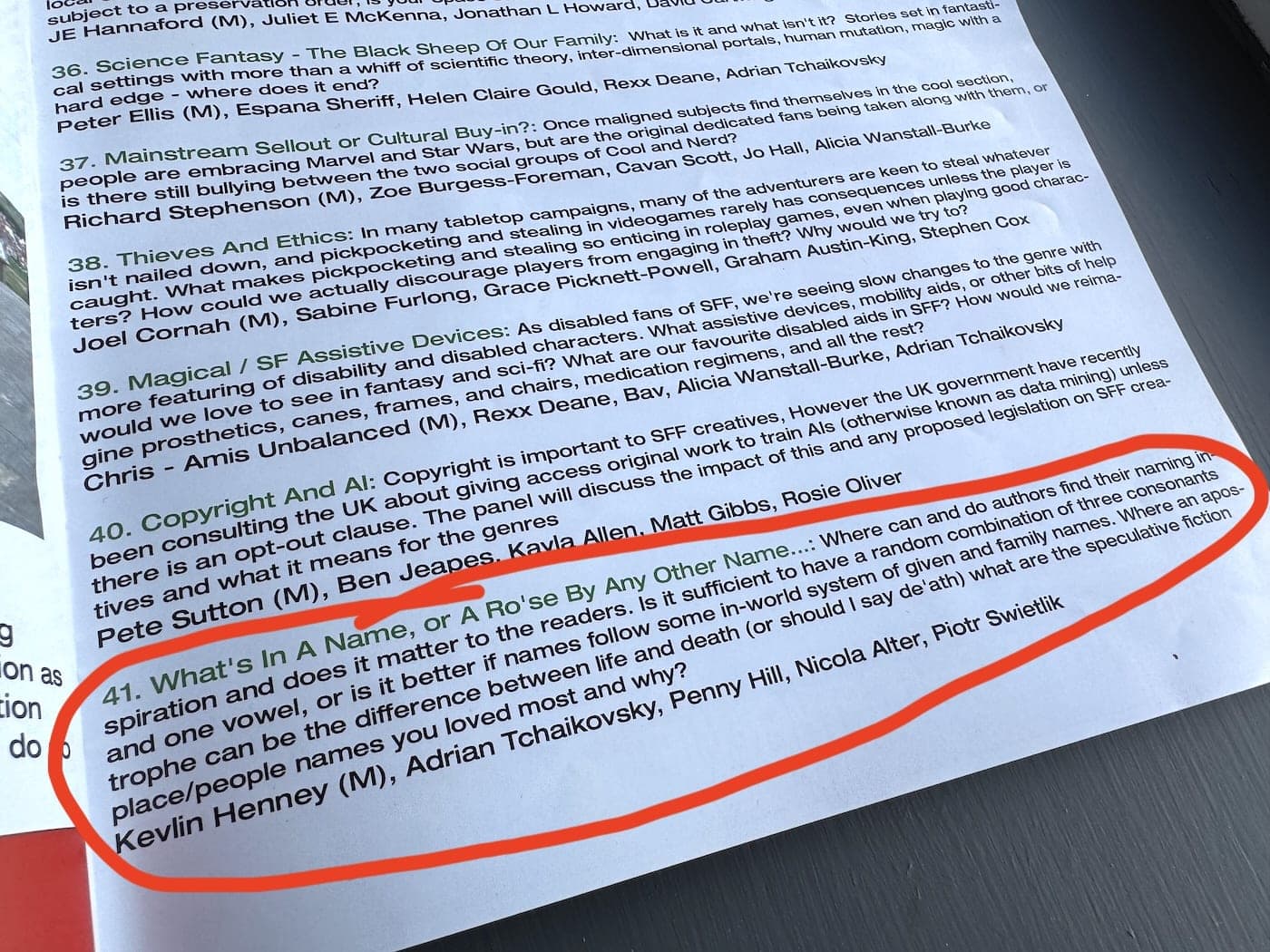
The second panel on Sunday was titled What’s in a name – a ro’se by any other name would smell as sweet, and having survived the first panel, I felt less nervous going into the second. Which was good, because crazily enough, I ended up sitting next to one of my favourite science fiction authors, Adrian Tchaikovsky, which was a real highlight – even if it made me a tad star struck. The other panellists were Penelope Hill and Piotr Swietlik, and the moderator was Kevlin Henney. The discussion felt like it could have kept going for three panels if time had allowed. I found it really interesting to hear how the other panellists go about choosing names for their fictional characters and places, and what their opinions were of the naming styles in everything from Star Wars to Lord of the Rings. But again, I’ll save the details for another post.
As is often the way with me, once I overcame the initial fear and “hurdle” of never having done something before, things got much easier, so I think I’ll be putting my hand up for panels at future cons too.
Indie and self-publishing in focus
I also attended a lot of other programme items, including an interview with one of the guests of honour, J.E. Hannaford, who was being interviewed by previous guest of honour Anna Smith Spark. It transpired that she is possibly the first ever self-published guest of honour at a UK SFF convention, so that was a nice milestone to be present for.
Bristolcon is generally great for celebrating self-published and indie authors, which was further highlighted by a panel I went to on Saturday evening about SPFBO (The Self Published Fantasy Blog-Off), a competition run once a year by author Mark Lawrence and judged by 10 volunteer SFF blogs.
I attended a SPFBO panel at Bristolcon last year too, even though I’ve never participated in the competition as either a judge or an entrant. I always enjoy the behind-the-scenes glimpse you get hearing from past and present judges, entrants, and finalists as they discuss what the competition is like to be part of both practically and emotionally. It also feels like there are new challenges for the competition to weather each year – for example, AI was a topic this time, given that previous issues with AI resulted in the discontinuation of the cover competition.
Other panels
I also watched some other really interesting panels over the weekend:
- SF as activism, about using SFF to influence people and bring change in the real world.
- Team Jacob and Team Nosferatu, about vampires, werewolves and zombies and whether they’ve been done to death or are still ripe sources of fictional enjoyment.
- What potions can’t heal, about the emotional, psychological, and physical trauma characters endure and what happens to them in terms of trauma recovery, PTSD, and other issues once the adventure is over.
- Lost cities and legends, about why we are repeatedly drawn to mythic sites and “lost” destinations like Atlantis, El Dorado and Shangri-La.
- Mainstream sell-out or cultural buy-in? about previously niche franchises and stories that gain mainstream appeal, how expectations change when something gains a broader audience, and what constitutes “selling out”.
Barcon, karaoke, and the dealer’s room
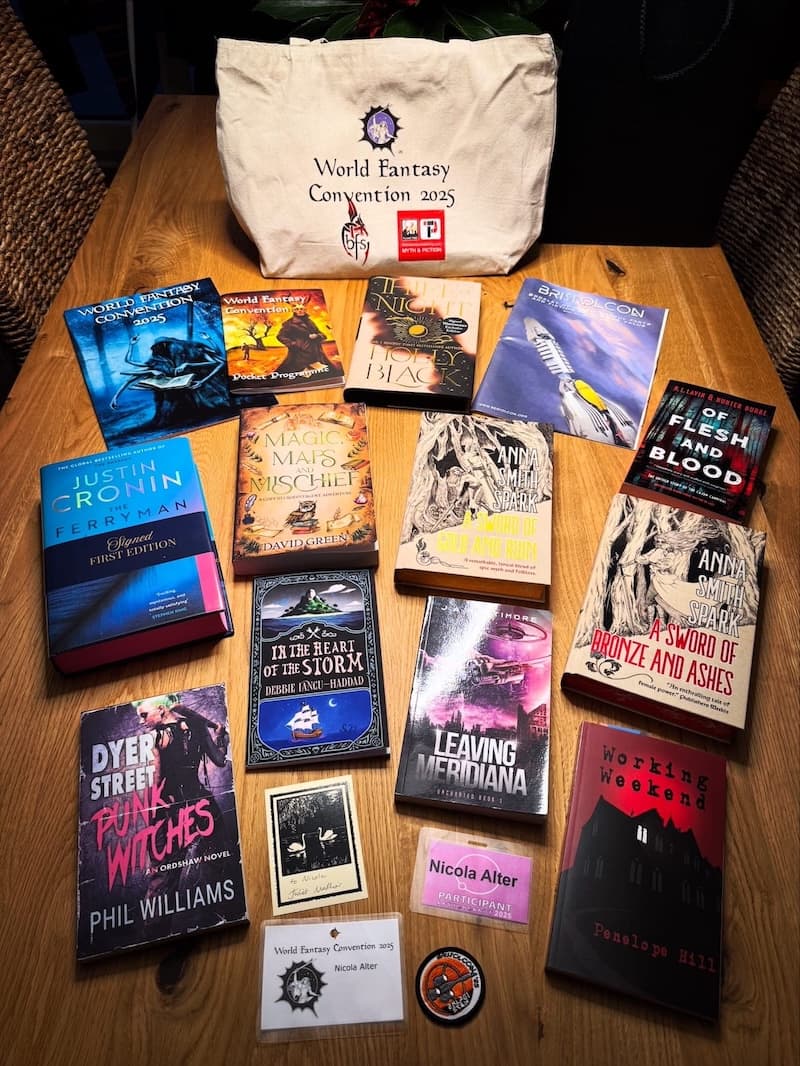
I did find time amidst all the panel-going to check out the dealer’s room and buy some books (I found myself tempted by some lovely hardcovers with sprayed edges, as well as a book by one of the other authors I was on a panel with, Penelope Hill, set at a con called Working Weekend). And of course, I chatted to people in the bar. Saturday evening ended with karaoke, which I watched, but was not brave enough to participate in. Maybe I’ll save that hurdle for next year…
Some people I normally see at Bristolcon couldn’t attend this year, either because life got in the way or because they were coming to World Fantasy Con the following weekend instead, which was a shame – but I still got to catch up with lots of friends, and also met a few new people.
A meet-up between the cons
I thought I would get more down time in the three ‘free’ days after Bristolcon, but of course I managed to fill those up too. On the Monday I met up with a group of writers from an online writing group (Shut Up & Write) that I have been joining, and sometimes hosting, for the past three years, which was lovely. There’s something about seeing people once a week over a long period of time, even if you only talk in brief online sessions and have never met in real life, where you still come to feel like old friends or colleagues… a feeling enhanced of course by the shared passion for writing.
A train journey with friends
On Tuesday I headed onward to World Fantasy Con, hopping on the train to Brighton with three friends. I often travel solo or with my husband on trains, but I’ve always envied those groups of friends I see sitting around tables in the train carriage having a grand old time chatting and laughing and eating snacks or drinking together as they head off to somewhere fun… so I finally got my wish!
As for what happened at World Fantasy Con, I’ll save that for another post.
___________________
Do you attend conventions or writer’s festivals? If so, do you have a favourite? And have you ever been on a panel? Share your own experience in the comments.
Discover more from Thoughts on Fantasy
Subscribe to get the latest posts sent to your email.

A lovely reflection on a great experience and you didn’t seem at all nervous on either panel – definitely very professional and assured, so you must volunteer more often! And you caught the sociability of the event – books and people, what’s not to like 😀 ?!
LikeLiked by 1 person
Thanks!! I’m glad I didn’t seem nervous, even if I most definitely was 😅 And I’ll definitely volunteer again in future I think, now that it’s not so “scary” anymore 😀
I’m looking forward to reading your post about the event too – it’s always fun to relive these things from another perspective through other people’s retellings!
LikeLiked by 1 person
Damn, I didn’t even know Bristolcon exists and I live in the city! I’ll have to check it out next year.
LikeLiked by 1 person
Oh cool, glad I could “advertise” it then 😀 Maybe I’ll see you there next year!
LikeLiked by 1 person
Nice post, and amazing that you overcame your nerves to be a panellist! I wasn’t aware that Bristolcon existed. It sounds really interesting and fun, so thanks for sharing!
LikeLiked by 1 person
Thanks, glad you liked it! And yeah Bristolcon is quite small and low key so not everyone has heard of it, but some writer/blogger friends introduced me to it one year and I’ve been going ever since.
LikeLike
I’m in America so the expectations may be different. Here, professionals are often comped in. Theoretically, our presence is a draw for other attendees. To pay back for that, we are expected to suggest topics and appear on several panels.
I’ve found panels are a great way to appear before an audience that might not have been interested in my books, and draw a few sales. It’s important to be personable, stay on topic, and contribute to the conversation rather than trying to draw all eyes to yourself.
Perhaps not surprisingly, panels here have changed a bit in the past 6 or 8 years. Some of them, on topics like writing during times of censorship, can get quite emotional and even grief stricken.
LikeLiked by 1 person
That’s interesting professionals are often comped in – here I get the impression it’s more like you pay/register to attend, then express interest in participating and suggest some topics, then mark what panels you’d like to be on once the list is made available (during the Bristolcon process attendees can also vote for which topics they’d like to see), then maybe get added to the program… but I’ve never been part of the process for a larger con.
That’s interesting you’ve noticed panels changing over the past 6-8 years, I can imagine why. I’ve attended a lot of panels in the UK as an audience member, and while most remain pretty light discussions, I’ve been to a few that got more emotional. In the current political climate discussions around censorship, author identity, and mental health can be so present and distressing. And I can imagine that would be even more so in the US ☹️
Anyway, thanks for sharing your thoughts, sounds like you are an experienced panellist!
LikeLike
Your blog posts are as informative as they are organized and fun. Thanks for including your own honest reactions to being a panelist. Looking forward to reading further editions.
LikeLiked by 1 person
Thanks Susan! ☺️
LikeLike
I have stumbled upon this and your World FantasyCon post while reminiscing fondly on both, and this has definitely added to that. I too am a particularly nervous panellist and moderator – I had trembling hands throughout my panel at WFC, but at BristolCon I was fortified by a few wee drams o’ whisky, courtesy of T.O. Munro!
LikeLiked by 1 person
Ah yes T.O. Munro and his whisky do help to smooth things out, they did for me too! 🙂 What panels were you on? Glad this post enhanced the reminiscing! I think T.O. Munro also did some after-con posts over at the Fantasy Hive which brought back good memories for me too.
LikeLiked by 1 person
Sorry for the late reply, I only just saw this. I was on the Jacob and Nosferatu panel you mentioned above. When I first read your report I saw it and thought, yeah, I went to that panel too!
And then it slowly dawned on me that I was actually ON it.
LikeLiked by 1 person