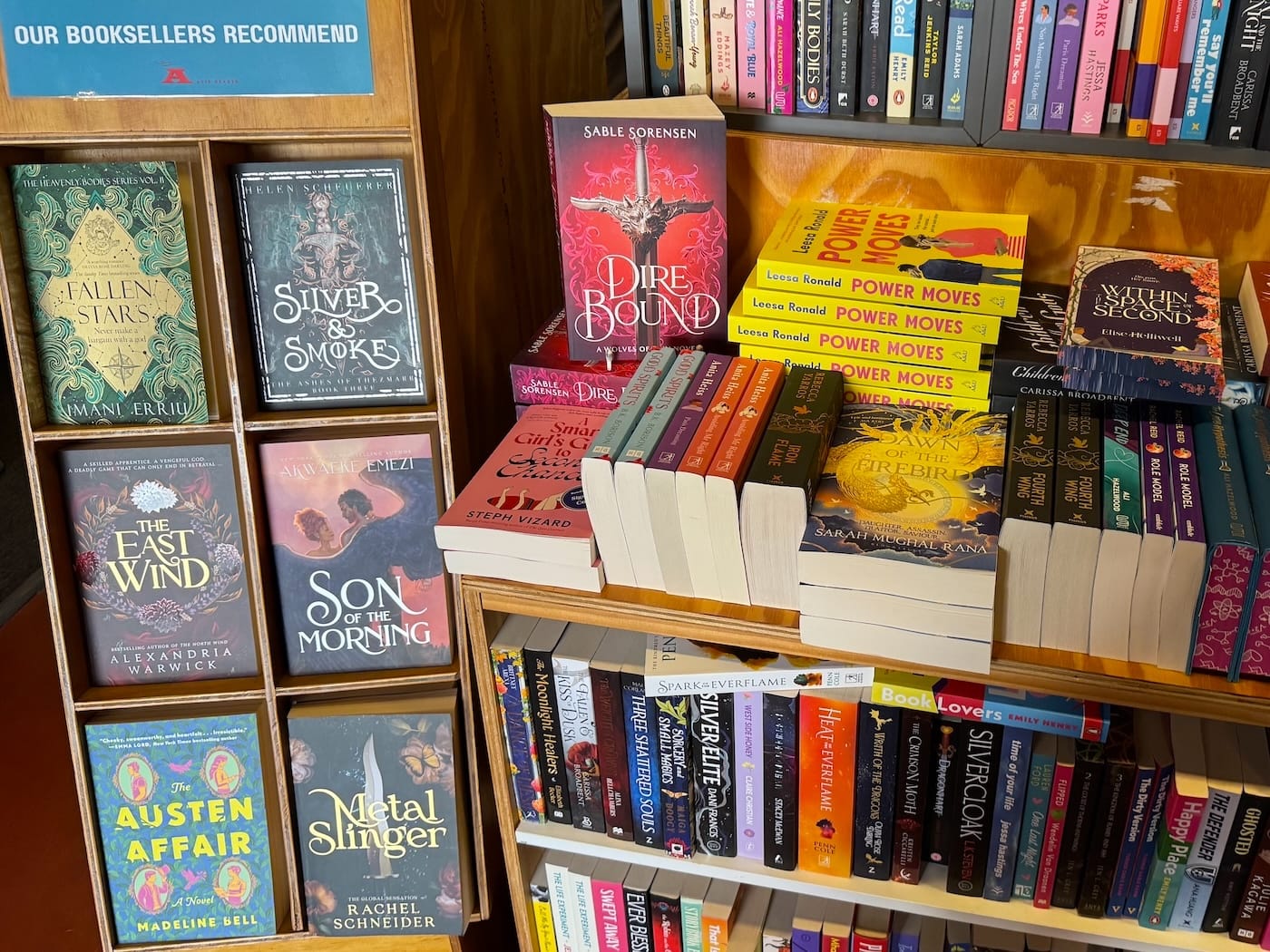
Romantasy and romance books on display at Avid Reader bookshop in Brisbane, 2026 (Photo: Nicola Alter)
Over ten years ago I wrote a post that ended up being one of my most read of all time. I had just come out of tutoring a course on genre fiction, and I was frustrated by the fact that when I looked up fantasy subgenres online I would get one of three things: a detailed look at a few specific subgenres that ignored all the others, a breakdown of someone’s own very personalised way of categorising things, or an epic three-digit list of every fantasy sub-genre under the sun, many of which I’d never heard of.
I’ve always loved science fiction and fantasy stories that focus on language, translation, and linguistics. And I’m not talking about the Tolkien-esque creation of whole fictional languages to furnish invented worlds, which I’m also in awe of, but about books where the very act of communication or translation itself becomes core to the plot.
Why do these stories appeal? I think it’s that mysterious sense that something needs to be “decoded”, the bridging of culture gaps, and the unlocking of exciting new possibilities for human (or non-human) connection. The theme of language itself also just inherently feels a little magical. The fact our brains are capable, with enough effort and exposure, to transform unintelligible babble into something meaningful, is remarkable. I admire the almost superpower-like ability of polyglots to shift seamlessly between different languages, and I enjoy encountering characters like this in stories.
I was recently thinking about one of my favourite novels, Piranesi by Susanna Clarke, and it reminded me that there’s a quality some science fiction, dystopian and speculative fiction stories have—a rare one—that I absolutely love. It’s hard to describe, and perhaps even harder to achieve, but I’d characterise it as a tantalising sense of wrongness intertwined with mystery, often (though not always) occurring at the beginning of a story, which usually precedes a giant, reality-altering twist.
It’s that growing conviction that things don’t make sense in the world, that something very odd is happening, perhaps even something sinister, but you don’t know what it is yet. You just have this sense that the situation is off, wrong somehow, and that you, and perhaps even the characters, have a fundamental misunderstanding of the reality in which they find themselves. At the same time, you can feel in your bones that you are going to find out what it is, and that when you do, it’s going to be a hair-prickling revelation or a fantastically unexpected twist. This feeling seems to often be evoked when the initial story world, or simply the story we think we are about to be told, is increasingly questioned, then ultimately flipped on its head.
The fantasy genre is rich with a myriad of subgenres, and each has its own conventions and trends. With the different terms floating around out there it can be easy to confuse or overlook key subgenres. Finding a succinct list of the most notable ones – particularly a list with definitions and examples – is not always straightforward. So I thought I’d put my reading and researching to use and assemble one.